
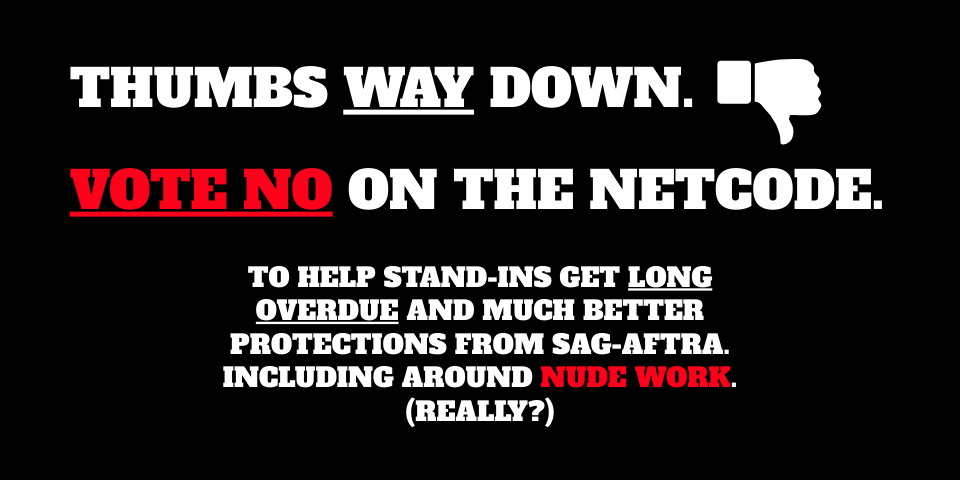
If you aren’t aware, SAG-AFTRA members are currently voting on a referendum on whether to ratify the tentative Network Television Code — here called the “Netcode.” The voting deadline is Wednesday, August 20, 2025. To influence your vote, SAG-AFTRA has published a referendum booklet found here.
The Netcode is a collective bargaining agreement SAG-AFTRA negotiated with studios that tend to produce soap operas and promos, shows with live studio audiences like variety shows and game shows, and other television projects. The Netcode covers the wages and working conditions of stand-ins and other SAG-AFTRA-affiliated unit employees when working on these productions.
(The Netcode does not cover television productions covered under the Television Agreement, which SAG-AFTRA negotiates opposite the Alliance of Motion Picture and Television Producers (the AMPTP). Those productions are typically “scripted” dramatic and comedy series, and they don’t have studio audiences typically.)
Basically, the Netcode is an old AFTRA agreement, while the Television Agreement is an old SAG agreement. After the two unions merged in 2012, SAG-AFTRA covered work under both agreements. This fact explains why terms and conditions of employment are so different for SAG-AFTRA unit employee when working under the Netcode and the Television Agreement.
In this post, we cover what SAG-AFTRA negotiated that applies directly to stand-ins. We also give our voting recommendations based on its tentative provisions. As you will read, Stand-In Central recommends voting No for many reasons in the referendum, so as not to ratify this tentative Netcode.
Potential for Diminished Wage Increases
In its letter introducing a summary of the tentative agreement, SAG-AFTRA’s negotiators write:
At the union’s discretion, a small portion of future wage increases are subject to a possible strategic reallocation to the AFTRA Retirement Fund as needed to strengthen members’ retirement benefits.
This means that the future wage increases SAG-AFTRA negotiated in this tentative agreement may not be as big, in the event SAG-AFTRA exercises “discretion.”
SAG-AFTRA has agreed to this kind of scheme in prior negotiations around the Television Agreement. In all or nearly all past opportunities, SAG-AFTRA has exercised its discretion and chosen a lower wage increase in turn to boost benefit plan contributions.
To make matters worse, SAG-AFTRA made no announcements to its membership that it did so on any of these occasions. Instead, SAG-AFTRA quietly updated its rate sheets to reflect a wage increase that was lower than SAG-AFTRA could have allowed is membership.
The effect of such a negotiated scheme is that SAG-AFTRA is able to promote to its voting membership wage increases that appear large, only to deflate them later, quietly, at the Union’s discretion.
Although it is truly discretionary for the Union to do this, given past patterns, it seems reasonable to see this kind of scheme as merely a ruse to permit SAG-AFTRA to advertise bigger gains than it will actually execute for its members — and it would be surprising to see the Union choose higher wage increases at this point.
A wage increase is a wage increase, though, of course, not all wage increases have the same effects. Naturally, a larger wage increase tends to benefit unit employees over a smaller wage increase. But a larger wage increase also tends to have more voting pull, making not all wage increases having the same effect. SAG-AFTRA announcing a 2.5% gain isn’t as special in the current economic climate as, say, a 3% gain. So in the event the Union only negotiated a 2.5% gain, it is understandable it would want to find a creative way to announce a higher gain than that.
Here is what SAG-AFTRA’s summary states about its tentative conditional wage increases:
At the Union’s election, up to .5% of the wage increases effective July 5, 2026 and July 4, 2027 may be redirected to the AFTRA Retirement Fund (“Retirement Fund”) contribution rate.
What the tentative wage increases are, are these:
3.5% effective July 6, 2025, 3% effective July 5, 2026 and 3% effective July 4, 2027 […]
So, if SAG-AFTRA membership ratifies this tentative agreement:
- on July 5, 2026, unit employees’ wage increases could be as low as just 2.5%, and
- on July 4, 2027, unit employees’ wage increases could be as low as just 2.5%.
SAG-AFTRA did not frame the negotiations on wage increases differently. For one, it did not simply negotiate 2.5% wage increases for 2026 and 2027, and decide to go for 0.5% for its benefit plans each year. As already stated, 2.5% wage increases do not look attractive, especially given current economic times, and especially given that many Netcode rates appear depressed to stand-ins who work under the Television Agreement, where they tend to receive more compensation for their work.
In terms of stand-ins, these wage increases only apply to the wages of certain Netcode stand-ins. The stand-ins to which they apply are those mentioned in Paragraph B(2), who are stand-ins on dramatic programs. These stand-ins work for a daily wage (effectively an 8-hour minimum), rather than other Netcode stand-ins, who work at an hourly rate with lower minimums than 8 hours.
All in all, Stand-In Central recommends voting No in this referendum because of SAG-AFTRA’s agreement to conditional wage increases, because this provision tends to serve the Union’s image rather than unit employees’ pocketbooks.
Wage Increases for “Hourly” Stand-Ins
As for stand-ins who work at an hourly, rather than a daily, rate, SAG-AFTRA’s summary of the tentative agreement states:
Stand-Ins: Increase the rate for Stand-Ins covered by Paragraphs 36.B.(1) by $2 to $36 effective July 6, 2025, by $1 to $37 effective July 5, 2026 and by $1 to $38 effective July 4, 2027.
This passage discusses the wage increases of arguably most stand-ins working under the Netcode. Fortunately, by the read of this summary passage, hourly stand-ins do not appear to be affected by the conditional wage increases to which SAG-AFTRA agreed in the tentative agreement, appearing to mean SAG-AFTRA has no discretion in the matter of whether these wage increases will be in full for hourly stand-ins.
Percentagewise, these increases may be better or worse than what daily stand-ins receive. If ratified, under the tentative agreement, hourly stand-ins would receive a wage increase of about 5.9% in year one, better than the 3.5% increase daily stand-ins would get. In year two, however, the increase will be about 2.8%, which may be more or less than what daily stand-ins get depending on SAG-AFTRA’s discretion over whether to give a 3% increase or something as low as a 2.5% increase for daily stand-ins. Similarly, in year 3, the increase will be about 2.7%, which is also more or less what daily stand-ins will receive depending on SAG-AFTRA’s discretion.
Arguably more importantly, though, note that SAG-AFTRA failed yet again to achieve daily wages for these hourly stand-ins. Producers continue to be permitted to pay stand-ins less than a daily wage, meaning stand-ins can be paid in some cases for just five hours of work under this tentative agreement.
This would mean a stand-in in this situation reporting to work then wrapping 5 hours later in year one would receive $180 ($36 x 5). However, such a stand-in could book stand-in work on a television series under the Television Agreement and be paid more for 5 hours of work, receiving an 8-hour minimum (at least $262 today). Similarly, that stand-in could work as a background actor under the Television Agreement and be paid more for 5 hours of work, also receiving an 8-hour minimum (at least $224 today).
What is worse, most stand-ins report to work on Netcode jobs without a clear understanding of how long their days will be, so they cannot practically make economic calculations that even background actors, say, under the Television Agreement can. Background actors might not know the length of their days, but they know they will make an 8-hour minimum, which is already more than the minimum some hourly stand-ins would get.
All in all, because SAG-AFTRA failed yet again to achieve daily minimums for all stand-ins under this tentative agreement, Stand-In Central recommends voting No in the referendum.
Increase to the Minimum Hours for Some Stand-Ins
The summary SAG-AFTRA published on the tentative agreement states:
Amend Paragraph 36B(1) as follows:
Increase the minimum call for stand-ins and/or dance-ins on prime time entertainment and variety programs one (1) hour or longer to five (5).
Here, the bolding of the phrase “and variety” is what is important. One famous Netcode variety program is Saturday Night Live.
This passage summarizes that the tentative agreement adds in stand-ins who work on variety programs to the Netcode paragraph covering hourly stand-ins, effecting to increase their minimum hours from 4 hours to 5 hours (as mentioned above).
Although this is a gain for these variety-program stand-ins, who were working with 4-hour minimums over the prior Netcode, this 5-hour minimum is still not an 8-hour daily rate.
Similarly, because SAG-AFTRA failed yet again to achieve daily minimums for all stand-ins under this tentative agreement — namely here stand-ins on variety programs — Stand-In Central recommends voting No in the referendum.
Nude Stand-Ins
SAG-AFTRA’s summary of the tentative agreement states:
Nude Stand-Ins: Should the AMPTP and SAG-AFTRA reach agreement prohibiting or otherwise related to stand-ins being required to work nude or partially nude (including, without limitation, in bathing suits, lingerie, sheer clothing, genital socks, etc.) in the upcoming negotiations for a successor SAG-AFTRA Television Agreement, the parties to the Network Code agree to adopt and adapt those changes consistently with the provisions of the Network Code within sixty (60) days of ratification of the Television Agreement.
This summary passage is alarming for a number of reasons.
Clearly, based on the content, the subject of nude stand-ins is of concern for SAG-AFTRA. It seems based on the language that some producers want to require stand-ins at times to work in states of undress, and otherwise refuse to hire them if they do not agree to that requirement.
However, despite this implied threat, in the negotiations for the tentative Netcode agreement, SAG-AFTRA failed to negotiate provisions prohibiting or related to stand-ins being required to work in states of undress. Instead, SAG-AFTRA appears to have kicked the can to future negotiations with a wholly different body — the AMPTP — covering a whole different area of television production. Those negotiations don’t start, in theory, until around June 2026.
At that, even if SAG-AFTRA and the AMPTP come to an agreement around requiring stand-ins to work in states of undress or even nude, then those provisions would not apply until 60 days after SAG-AFTRA members ratify that presumed future tentative Television Agreement.
What is even more troubling is that the interests of stand-ins working under the Television Agreement may not match the interests of stand-ins working under the Netcode.
Recall that many Netcode stand-ins work before live studio audiences, where nudity by an on-camera performer is rare. A Netcode stand-in may reasonably expect there would be little chance to encounter a job requiring nude stand-in work. However, a stand-in on a film or cable or streaming television series produced under the Theatrical Agreement or Television Agreement could more reasonably expect to encounter a scene with nude performers, with possibly a producer of such production requiring stand-ins to work in states of undress.
Why SAG-AFTRA is appearing to let producers of television productions that arguably are more explicit than those television shows produced under the Netcode have a say in the work conditions of Netcode stand-ins is outrageous and alarming. This tentative agreement appears to do badly not only by showing an understanding that stand-ins are under threat of their employers’ requiring undressed stand-in work, but also by failing to nail down provisions for Netcode stand-ins now. In theory, this means that if SAG-AFTRA members ratify the tentative agreement, and if SAG-AFTRA members also ratify a future tentative Theatrical/Television Agreement around August 2026, then Netcode stand-ins will be vulnerable for the next 14 months to a producer requiring them to work nude or in states of undress without negotiated provisions.
Because SAG-AFTRA failed to protect stand-ins from nude stand-in work and the like, and kicked the can to negotiations with a different bargaining opponent covering stand-in work of a different expected character, Stand-In Central recommends voting No on the referendum around the tentative Netcode.
What Happens If Not Ratified
If a majority of SAG-AFTRA members who vote in the referendum vote No, then the tentative agreement will not go into effect, and the present terms and conditions of employment will remain in effect for the time being. From there, SAG-AFTRA and the studios opposite whom it negotiated will continue to negotiate a (new) tentative agreement.
Although the Union might find such an outcome disgruntling, its charge is to negotiate a tentative agreement its voting members will ratify. Some terms and conditions of employment may change under such renegotiation, but that is not necessarily a bad outcome. In fact, if SAG-AFTRA negotiates terms and conditions still disfavored by its voting members, a majority may again fail to ratify a subsequent tentative agreement.
With that said, as per usual, Stand-In Central expects SAG-AFTRA voting members will, as a majority, vote Yes and thereby ratify the agreement, putting into effect the provisions around stand-ins this tentative agreement objectionably achieved, and pushing off another few years provisions SAG-AFTRA has continued to fail to achieve in negotiations.
So, if you want to vote Yes because you like the provisions, certainly vote Yes in the referendum.
And if you want to vote No because you do not like the provisions, certainly vote No in the referendum.
But if you have no skin in in the game, or do not care about voting one way or the other, vote No. Please push your union to negotiate and work much harder for Netcode stand-ins — to protect them from nude work, to protect them from conditional wage increases, and to provide them all with daily rates, not merely hourly rates.
Your No vote can actually serve to help stand-ins get what they have long needed — better wages and working conditions negotiated by their union.
Have your own opinions about the tentative Netcode agreement? Post your opinions in the comments box below!
Discover more from Stand-In Central
Subscribe to get the latest posts sent to your email.






Leave A Comment