
If you work as a stand-in on a SAG-AFTRA job in the New York City area or in the Los Angeles area, or in other places in California, Hawaii, or New Mexico, you may have heard the job is “in the Zone” or “out of the Zone.” Or you may have heard debate about whether a stand-in job was in or out of “the Zone.”
In this post, we talk about what “the Zone” means in each area, as well as share some easy tools for figuring out whether your job is in or out of “the Zone.”
Be sure the jump to the bottom for links to easy tools for calculating whether your job is in or out of “the Zone”!
What Is “The Zone”?
Technically, “the Zone” refers to “the Studio Zone.” The term is a product of collective bargaining between SAG (in the past) and SAG-AFTRA (now) and the Alliance of Motion Picture and Television Producers (the AMPTP).
- When a production is “in the Zone,” that means background actors (including stand-ins) do not receive travel time when arriving at or leaving the production for the day. Basically, when they wrap on set, that is their wrap time.
- When a production is “out of the Zone,” that means background actors (including stand-ins) receive travel time when arriving at and leaving the production for the day. Basically, when they wrap on set, their wrap time is not until they land back at their original pickup point. (In the case of background actors and stand-ins who drove to the set, they receive an agreed-upon wrap time that is later than their wrap time on set.)
“The Zone” is the circular area from a certain point in New York City or in Los Angeles. Inside this area, a production is “in the Zone.” Outside this area, typically the production is “out of the Zone.”
It is important to note that these Zone-related distances are measured “as the crow flies” (sometimes called “air miles”). In other words, they are measured as straight lines from these certain points. They are not the driving distance from these certain points.
What Zones Are There?
Zones apply when union stand-ins work on films covered by the Theatrical Agreement, or on television shows covered by the Television Agreement.
The New York Zone
Schedule X, Part II (found toward the end of the Theatrical Agreement), covers background actors working in the New York Zone.
Its Section 32, “New York Zone,” states in relevant part:
The New York Studio Zone shall mean the territory within a radius of eight (8) miles from Columbus Circle.
So, any production within 8 miles of Columbus Circle (found at the intersection of Central Park West and Central Park South in Manhattan) is “in the Zone.” If the production is beyond 8 miles from this point, it is “out of the Zone.”
The Los Angeles Zone
Schedule X, Part I (found before Schedule X, Part II), covers background actors working in the Los Angeles Zone.
Its Section 31, “Los Angeles Zone,” states in relevant part:
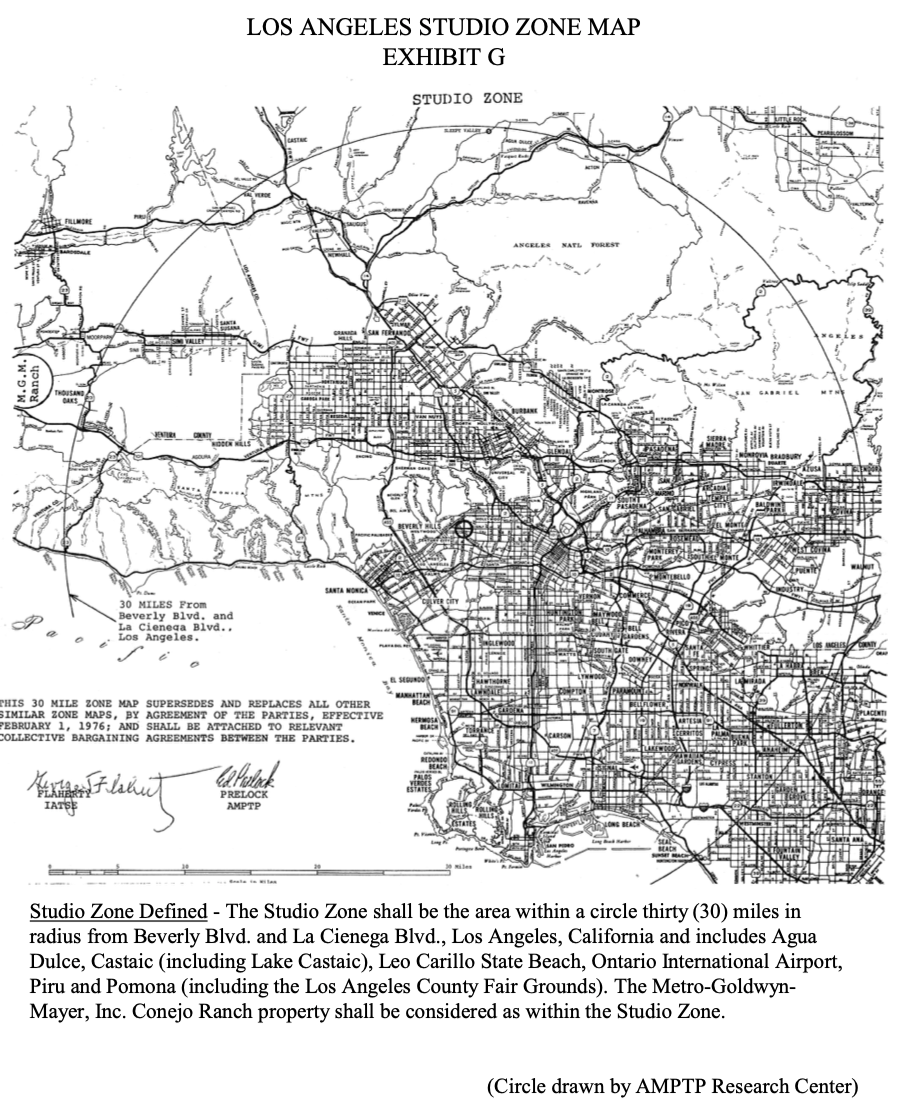
The “Studio Zone” within the Los Angeles Background Actor Zone shall be the area within a circle thirty (30) miles in radius from the intersection of Beverly Boulevard and La Cienega Boulevard, Los Angeles, California, and shall also include Agua Dulce, Castaic (including Lake Castaic), Leo Carillo State Beach, Moorpark, Ontario International Airport, Piru and Pomona (including the Los Angeles County Fairgrounds). The Metro-Goldwyn-Mayer, Inc. Conejo Ranch property shall be considered as within the studio zone.
Basically, any production within 30 miles of the intersection of Beverly Blvd. and La Cienega Blvd. is “in the Zone.” If the production is beyond 30 miles from this point, it is “out of the Zone” — except for those locations Section 31 lists.
To clear up some confusion, Schedule X, Part I, includes a map under its Exhibit G. The map depicts the Los Angeles Zone. Just to the west, the MGM Ranch property, which is outside the circle, has its own circle and is defined also as “in the Zone.”
The San Francisco Zone
Schedule X, Part I, covers background actors working in the San Francisco Zone.
Its Section 1(d)(2) mentions and defines the San Francisco Zone.
It states in relevant part:
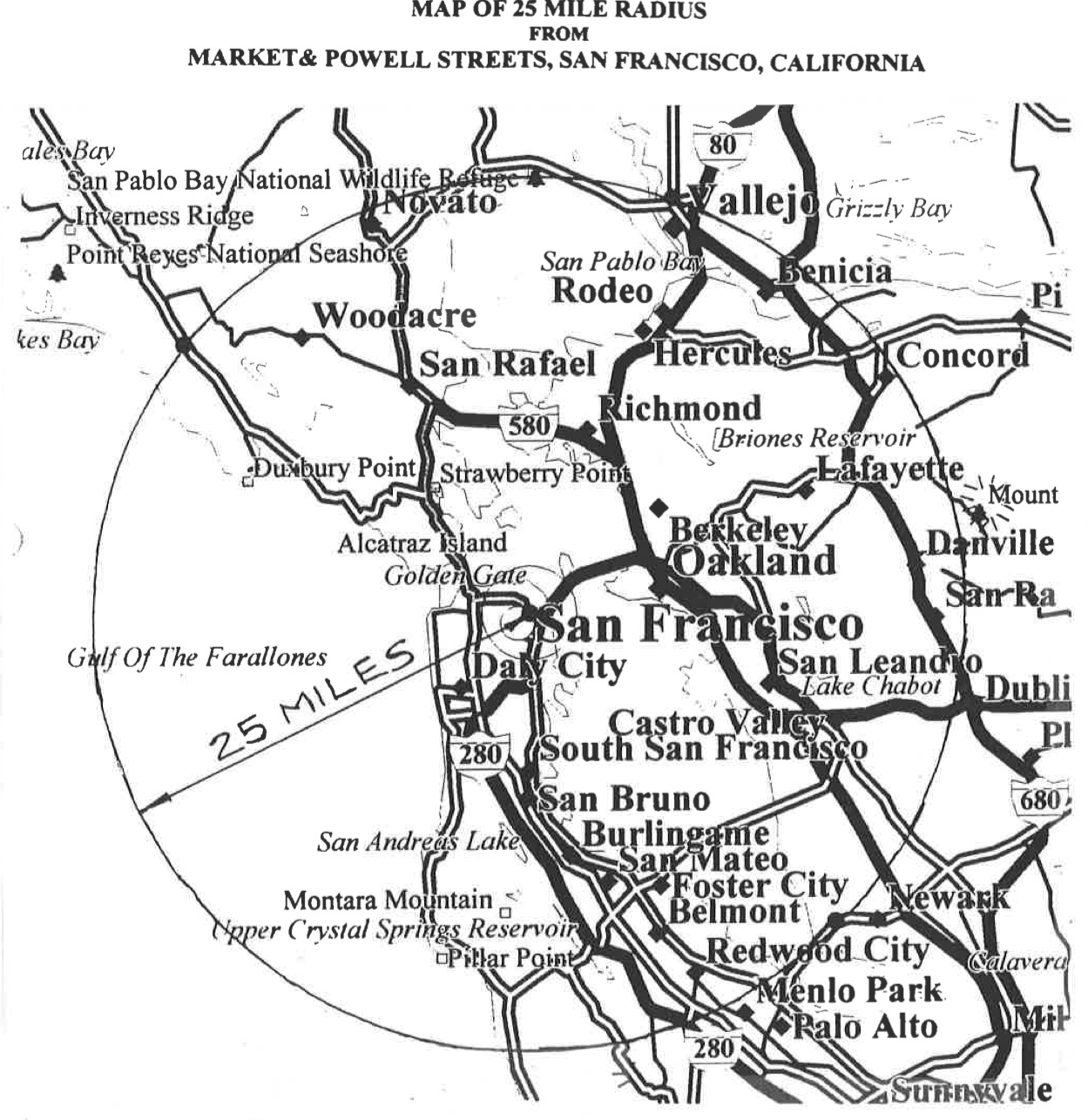
The “San Francisco Background Actor Zone” referred to by this Schedule shall be an area within a circle twenty-five (25) air miles in radius from Market and Powell Streets, San Francisco, California.
So, any production within 25 miles of the intersection of Market St. and Powell St. is “in the Zone.” If the production is beyond 25 miles from this point, it is “out of the Zone.”
However, Section 32(b) states, “There are no nearby locations within the San Francisco Background Actor Zone.” It is not entirely clear what this passage means. Technically, a “nearby location” tends to mean a location that is “out of the Zone,” and a nearby location cannot be “in the Zone.” So by stating “There are no nearby locations within the San Francisco Background Actor Zone,” seems like a tautology. Contact SAG-AFTRA for guidance on any work over 25 miles from Market St. and Powell St.
To clarify the San Francisco Zone, Schedule X, Part I, includes a map under its Exhibit F.
The Hawaii Zone
Schedule X, Part I, covers background actors working in the Hawaii Zone.
Its Section 1(d)(3) mentions and defines the Hawaii Zone.
It states in relevant part:
The “Hawaii Background Actor Zone” referred to by this Schedule shall be an area consisting of the State of Hawaii […]
Basically, any production in the State of Hawaii is “in the Zone.”
The Las Vegas Zone
Schedule X, Part I, covers background actors working in the Las Vegas Zone.
Its Section 1(d)(4) mentions and defines the Las Vegas Zone.
It states in relevant part:
The “Las Vegas Background Actor Zone” referred to by this Schedule shall be an area within a circle fifteen (15) air miles in radius from the Clark County Courthouse.
So, any production within 15 miles of the Clark County Courthouse (201 E. Clark Ave., Las Vegas, NV 89101) is “in the Zone.” If the production is beyond 15 miles from this point, it is “out of the Zone.
The San Diego Zone
Schedule X, Part I, covers background actors working in the San Diego Zone.
Its Section 1(d)(5) mentions and defines the San Diego Zone.
It states in relevant part:
The “San Diego Background Actor Zone” referred to by this Schedule shall be an area consisting of the City of San Diego, California, and extending to the city limits of that city.
Basically, any production within the city limits of San Diego is “in the Zone.” If the production is outside the San Diego city limits, it is “out of the Zone.”
The Sacramento Zone
Schedule X, Part I, covers background actors working in the Sacramento Zone.
Its Section 1(d)(6) mentions and defines the Sacramento Zone.
It states in relevant part:
The “Sacramento Background Actor Zone” referred to by this Schedule shall encompass an area within a circle twenty-five (25) air miles in radius from an agreed-upon point in Sacramento, California.
This Section does not clarify the point centering the Zone for Sacramento, so it is not entirely clear from the Section what constitutes being “in the Zone” and “out of the Zone” when working in Sacramento. Contact SAG-AFTRA for the “agreed-upon point” from which the Zone is calculated for productions in Sacramento.
The Albuquerque Zone (for Netflix Productions Only)
The 2022 Netflix Agreement covers film and television productions produced by Netflix.
Its Section 6, “Albuquerque Background Actor Zone,” covers background actors on Netflix productions working in the Zone around Albuquerque, New Mexico.
It states in relevant part:
The “Albuquerque Background Actor Zone” referred to by this Schedule shall be an area within a circle of thirty (30) air miles in radius from the Albuquerque City Hall.
So, any production within 30 miles of Albuquerque City Hall (1 Civic Plaza NW, Albuquerque, NM 87102) is “in the Zone.”
This Section 6 also states that Section 32, “Nearby Locations Defined,” “shall not apply.” It is unclear what that means in case of work outside 30 miles from Albuquerque City Hall. Contact SAG-AFTRA for guidance on any work over 30 miles from Albuquerque City Hall.
Determining Whether Your Work Is In or Out of “the Zone”
Here is how to calculate whether your work is in or out of “the Zone”:
- Find out the address of your report location.
- Figure out from above the center point for the Zone that applies for your geographic area, if any.
- Use an online tool (or app) that calculates the distance between them “as the crow flies.”
A quick googling for “crow flies” should generate a list of websites that will calculate the “air miles.”
Here are a few that come up today:
- Free Map Tools – How Far Is It Between (Editor’s Pick)
- How far is it? – Distance Calculator
- DistanceAsTheCrowFlies.com
In the case an app doesn’t recognize an intersection as a starting point, it may recognize a landmark. For example, Free Map Tools does not recognize Beverly Blvd. and La Cienega Blvd. as a starting point, but it recognizes “Beverly Center,” which is at that intersection. So, try a landmark that is at or near the intersection to see if it comes up.
Be sure when reading the results you are reading them in miles (not kilometers) and the distance as the crow flies (not land miles). The Editor once made the mistake of reading the land miles accidentally, so thought he was working out of the Zone when he was not!
Conclusion
Understanding whether you are in or out of “the Zone” is very helpful for understanding whether you are due travel time when you are working a little out of the way in your home jurisdiction. Some productions may work you very close to the edge of your Zone but inside it. Sometimes holding where you might report may be in the Zone, but the set may be out of the Zone! Knowing your “Zone facts” will help protect you — and your paycheck!
Have any other good tips for calculating distance “as the crow flies”? Do you have other tips for figuring out whether you are in or out of “the Zone”? Post your thoughts in the comments box below!
Discover more from Stand-In Central
Subscribe to get the latest posts sent to your email.




Leave A Comment