
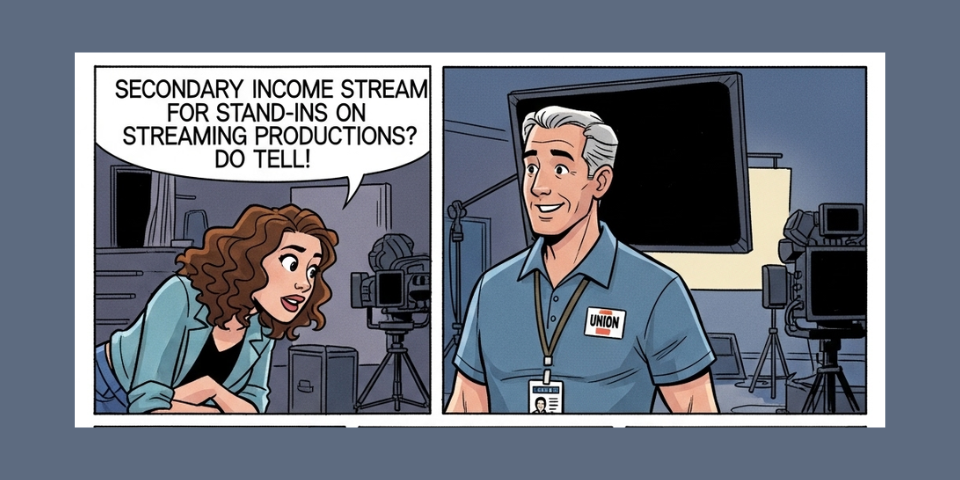
SAG-AFTRA recently announced more details about a fund negotiated between the Union and the Alliance of Motion Picture and Television Producers (the AMPTP). In that announcement, SAG-AFTRA clarified that some stand-ins will be eligible to receive secondary income for their work on certain made-for-streaming productions, subject to eligibility details the Union states will come in weeks.
About the Fund
In 2023, SAG-AFTRA and the AMPTP concluded a strike with a memorandum of agreement (MOA) pertaining to their Theatrical and Television Agreements, which covers many films and television projects on which stand-ins regularly work. SAG-AFTRA members later ratified that MOA.
Section 12 of that MOA is titled “Success Bonus for High Budget SVOD Programs,” and it covers the fund SAG-AFTRA recently announced. This fund specifically applies to “Programs Made for New Media” under the Theatrical and Television Agreements, exhibited on or after January 1, 2024. This section of the MOA provides the calculation of a “Success Metric” for the determination of what, if any, “Success Bonus” should be paid out for work on one of these “Programs Made for New Media.”
Section 12 goes on to include language around the name of this fund. The MOA states it will be called the “SAG-AFTRA–Producers Success Bonus Distribution Fund” (SBDF).
The MOA Awards Success Bonuses Only to “Performers”
The MOA speaks only of “performers” being the recipients of Success Bonuses.
Why “performers” is important language in the MOA is because the MOA seemed to mean that background actors and stand-ins (a type of background actor in this case) would not be eligible to receive Success Bonuses. This is because the Theatrical Agreement clarifies in the first paragraph of Section 1(A) that “Background actors are not considered ‘performers.'” Under the Theatrical Agreement, stand-ins are a type of background actor.
This consideration is applied to the Television Agreement as well. These major union contracts are designed such that whenever there is a mention of “performers,” the language and provisions do not pertain to background actors or stand-ins.
However, study of SAG-AFTRA’s publications and other speech over recent years has shown it regularly calls background actors “background performers” when talking of their work under these contracts. A simple search of the SAG-AFTRA website for the term “background performer” (performed on September 16, 2025) yielded a number of results showing the Union’s use of the term. Stand-In Central believes this union conduct is contractually problematic and potentially misleading, leading background actors to believe they are considered “performers” when contractually they are not so, and so do not get to enjoy the same contract provisions that performers under the contracts do.
But Stand-Ins and Other Background Actors Can Get Success Bonuses, Too?
As a result, there would theoretically be some contractual problems around the awarding of stand-ins and other background actors Success Bonuses for their otherwise eligible streaming work. But apparently not — because SAG-AFTRA announced:
[…] the Fund’s union trustees achieved two major milestones. [T]hey secured inclusion in the Fund’s payment model of stand-ins, stunt riggers and background actors with a significant connection to a qualifying project, marking the first time performers in these categories will receive secondary use payments.
Again, SAG-AFTRA confuses stand-ins and background actors as “performers” despite their own longstanding signatory agreement that “Background actors are not considered ‘performers.'” However, insofar as paying Success Bonuses to eligible stand-ins and other background actors is a legitimate practice, then arguably it is a win for these types of employees on a production.
Eligibility
So far, we understand the following details apply to stand-ins and other background actors when working on a Program Made for Streaming in order to become eligible for a Success Bonus, per SAG-AFTRA’s announcement:
- “The Fund applies to high-budget made-for streaming productions first exhibited on or after Jan. 1, 2024, that meet the guidelines established by the [Fund’s] trustees.”
- “[…] members from both the stunts and background communities who work a minimum of 25 days will receive the bonus […]”
Stand-In Central presumes that when working on a streaming production that works under the Theatrical Agreement or the Television Agreement, stand-ins who work 25 days or more will be eligible for a Success Bonus, insofar as the production meets the criteria of being “successful.”
Some questions, of course, come to mind:
- What counts as a “day”? For example, if a stand-in attends an interview and receives a quarter check, then goes on to work 24 days on the production, does the interview work date count as a day, or something less than a day? Would the Fund round up 24.25 days to 25 days?
- Does the stand-in have to work as a stand-in each of these 25 days? For example, if a stand-in works 20 days as a stand-in but does only background work on the production for 5 days, did the stand-in become eligible for a possible Success Bonus?
- Does working more than 8 hours in a day constitute more than 1 day?
More details will come in the relatively near future, SAG-AFTRA indicates.
Conclusion
Although some people welcome more money, some people also say “more money, more problems.” It is hard to understand the grievance process today in the event one believes he or she is eligible for a Success Bonus and is not paid it, or is paid less than expected. There may be unemployment income implications for some stand-ins and background actors, too, in the event they are unemployed but then receive a Success Bonus payment related to their work. (Stand-In Central does not know if that is even a complication.)
All in all, it seems as if the SBDF will be a good thing for stand-ins, rewarding their often uncredited work on successful streaming productions. But the vagaries around eligibility, and the opacity around what kinds of actual money will come to stand-ins receiving a Success Bonus, make Stand-In Central a little hesitant to be purely celebratory about this secondary income stream to which some stand-ins may gain access.
What are your thoughts about this fund for stand-ins? Pros only? Cons? Share your thoughts in the comments box below!
Discover more from Stand-In Central
Subscribe to get the latest posts sent to your email.




Leave A Comment