
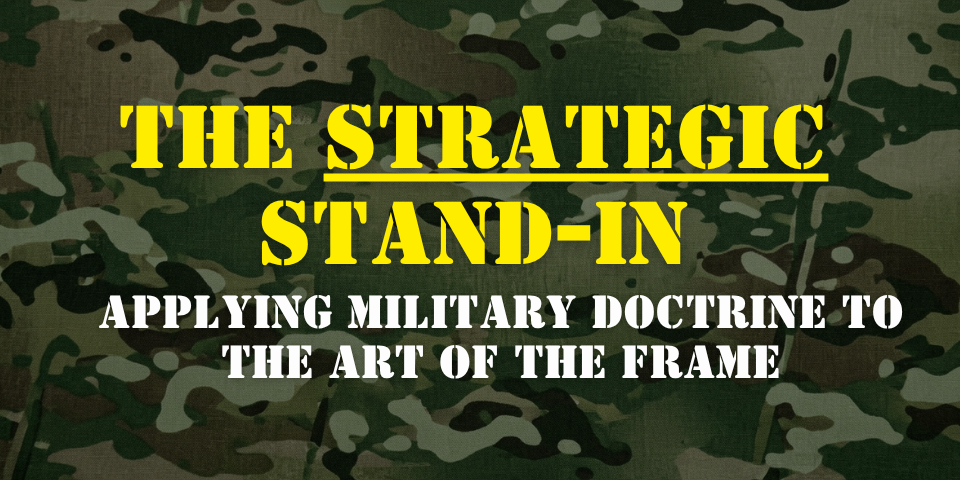
Welcome our newest contributor, Thaliya Martinez, to Stand-In Central! Thaliya recently relocated to Los Angeles after developing extensive stand-in experience in Chicago. In addition to working as a stand-in, she is also a second lieutenant in the National Guard and a filmmaker. Her first article for Stand-In Central demonstrates how her military background aids her work as a stand-in.
— The Editor
The transition from a military environment to a film set isn’t as much of a leap as one might think. As a Logistics Officer (90A MOS) in the U.S. Army, I am a master planner responsible for the movement of personnel and equipment.
In the language of TV and film production, “MOS” means “without sound.” It describes a shot in which production is not recording sound. But in the military, “MOS” stands for Military Occupational Specialty, and the “A” stands for Alpha—it is your professional identity and skill set.
My 90A training has become my greatest asset while navigating professional sets in stand-in and background capacities. From the high-volume pace of the One Chicago franchise to the technical environments of Dark Matter and The Chi, I treat every production as vital field research, applying military-grade precision to the cinematic process.
Both worlds share a singular goal: ensuring a complex operation is executed with absolute precision. Here is how I translate Army discipline into the language of the lens.
Translating the Chain of Command
To a filmmaker, military terms can sound like a foreign language, but the structures are parallel.
On a film set, the director is the Commander. In the Army, we rely on the Commander’s intent—a clear, concise directive that explains the ultimate goal of a mission without micromanaging every step.
On set, that “intent” is the vision for the shot. When I understand the director’s intent, I can anticipate the first team actors’ movement.
- The Tactical Edge: If I notice the director is favoring a tight close-up that requires the actor to lean in to catch a specific shadow, I don’t wait for a “mark.” I adjust my body during the lighting setup to give the camera crew that exact look. The goal is to have the shot 100% ready before the actor even arrives.
I view the key assistant director (AD) much like a Platoon Sergeant (PSG). In the Army, the PSG is the senior “boots on the ground” leader managing the rhythm of the day.
As a stand-in, I treat the AD with the same level of “tactical discipline” —staying reserved, attentive, and physically available. A missing stand-in creates a “hiccup” in the flow, and in my world, a “hiccup” is a failed mission.
The WARNO: Studying the Call Sheet
In the military, we use a Warning Order (WARNO). This is a preliminary notice that provides the “who, what, when, and where” of a task, allowing a unit to begin movement.
Every stand-in knows the call sheet is our roadmap, but I study mine with the intensity of a Mission Brief. I’m looking for more than just my call time; I’m looking for the “terrain”:
- Which director of photography (DP) is shooting?
- What is the block-and-shoot schedule?
- Are there heavy visual effects (VFX) or stunts?
By the time I step onto the soundstage, I am already mentally “on set.”
The Hustle of the 90A: Logistics of the Frame
In Military Doctrine—the fundamental principle that guides our actions—we use precise protocols to move a unit. On set, I trade those for the technical needs of the DP.
As a Logistics Officer, I see the stand-in as the “logistics of the frame.” I am responsible for providing the correct height, skin tone reference, and props to the mark, at the exact moment the camera team needs them.
- Situational Awareness: This is a military term for “Knowing what is happening around you at all times.” For a stand-in, this means tracking the dolly track, avoiding stinger cables (power cords), and knowing where the key light is falling.
- The Human Target: Since the DP can’t see the lead actor yet, I am the reference point. I study the lens choice to see how it affects the frame. By “hustling” to provide the perfect reference, I ensure that when the first team actors walk in, they step into a space that is already perfectly calibrated.
Intellectual Observation in “Holding”
In the Army, every officer must first master the basic skills of a Soldier before they specialize.
I apply this same philosophy to film. While waiting in holding (the designated area for background and stand-ins), I avoid the “distraction of the phone.”
Instead, I practice Intellectual Observation. I study:
- Lighting Placement: How are they shaping the light for their specific mood?
- Communication: How does the gaffer (head of lighting) interpret the DP’s instructions?
- Movement: How does the camera operator navigate a complex 360-degree shot?
Building the “Book of Everything”
I am constantly building my own personal doctrine. In the military, we have manuals for everything.
On set, I keep a “Book of Everything”—a master archive where I integrate my film school studies and technical notes with the practical realities of every department—from the first line of the call sheet to the final cut of the edit.
I am learning the foundation of the set from the ground up. Whether I am in the Army Combat Uniform or standing on a mark, I am refining my craft.
My goal is to eventually lead my own Brigade—a large, unified team—as a director. To lead the “mission” of a feature film, you must first understand the logistics of the individual frame.
Have you applied military experience to your stand-in work? Share your experiences in the comments box below!
Discover more from Stand-In Central
Subscribe to get the latest posts sent to your email.



Leave A Comment